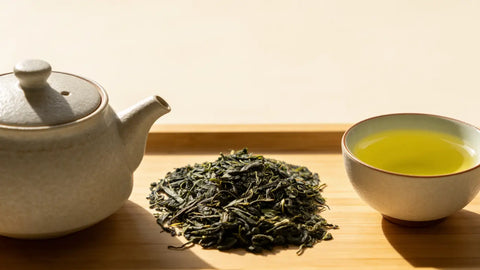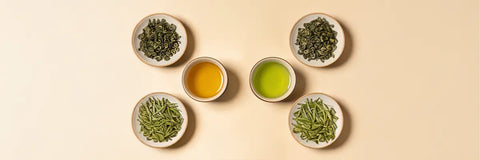
Tamaryokucha vs sencha comes down to one key difference: Tamaryokucha has curled leaves and a mellower, lower-astringency flavor, while sencha is brighter, grassier, and more widely consumed.
Both teas come from the same Camellia sinensis plant, both are steamed to preserve their green colour, and both produce a clear, green cup. But from that shared starting point, they go in noticeably different directions in terms of flavour, leaf shape, and how they are processed.
Sencha is Japan's most widely drunk loose leaf tea, accounting for roughly 35 to 40% of domestic production. Tamaryokucha, also called guricha, sits at the opposite end of the availability spectrum, around 3% of total output, and offers a mellower, less astringent experience for those who find standard Japanese green teas a little sharp.
This article covers how each tea is defined, how its processing differs, how they compare in flavour and caffeine, and which one is better suited to your needs.
Let's get started!
Tamaryokucha vs Sencha: The Key Differences at a Glance

Tamaryokucha vs sencha differs mainly in leaf shape, flavor, and caffeine. Tamaryokucha produces a smoother, lower-astringency cup with curled leaves, while sencha offers a brighter, grassier profile with higher caffeine and straight needle-shaped leaves.
The table below gives a direct comparison of tamaryokucha vs sencha across the most important factors. The sections that follow explain each point in more detail.
| Tamaryokucha | Sencha | |
|---|---|---|
| Also known as | Guricha (curly tea) | Infused Tea |
| Leaf shape | Coiled, comma-shaped | Straight, needle-shaped |
| Flavour | Mellow, nutty, light berry tartness | Grassy, bright, clean umami |
| Astringency | Low | Moderate |
| Caffeine | 20–35 mg per serving | 40–62 mg per serving |
| Main growing region | Kyushu (Ureshino, Sonogi) | Shizuoka, Uji, Kagoshima |
| Share of Japanese production | ~2–3% | ~35–40% |
Tamaryokucha: A Curled Japanese Green Tea Also Known as Guricha
Tamaryokucha translates literally as 'jewel green tea.' The more common nickname, guricha, simply means 'curly tea' and refers to the most obvious thing about it: the leaves do not end up in the straight needle shape typical of sencha. Instead, they coil into a loose, comma-like curve that makes tamaryokucha immediately recognisable in the palm of your hand.
For readers looking to define tamaryokucha tea sencha terminology, the simplest distinction is that tamaryokucha refers to the curled-leaf style, while sencha describes the more common needle-shaped Japanese green tea.
This tea is produced almost entirely in Kyushu, in regions like Ureshino in Saga Prefecture and Sonogi in Nagasaki Prefecture. Ureshino has over 600 years of recorded tea cultivation history and wins at national tea competitions with some regularity. Production stays small by design, around 3% of total Japanese tea output, which is why it remains unfamiliar to most drinkers outside Japan.
The low astringency and health benefits of tamaryokucha are among its most defining traits. Because tamaryokucha skips the final rolling stage that sencha undergoes, less of the catechin content is expressed into the brew, resulting in a noticeably softer cup that is forgiving to prepare and accessible even for those who find standard Japanese green tea too sharp.
Sencha: Japan's Most Popular Green Tea

Sencha is the tea most people picture when they think of Japanese green tea, and it represents the more familiar side of any tamaryokucha vs sencha conversation. It covers roughly 35 to 40% of domestic production and is the everyday tea served at homes, restaurants, and workplaces across the country. Understanding sencha is essentially the baseline for understanding all Japanese loose leaf tea.
The defining characteristic of sencha is its processing. After steaming, the leaves are rolled repeatedly into their characteristic straight needle shape and dried. This rolling concentrates flavour compounds and gives sencha its clean, grassy taste with clear umami notes on the finish. Good sencha has a pleasant bite that comes partly from its catechin content and partly from the precision of the rolling process.
Sencha is produced across many regions, with Shizuoka, Kagoshima, and Uji being the most widely recognised. Within the category, there are also subcategories. Fukamushi sencha uses a longer steaming time and produces a thicker, less astringent brew. If you want to explore what separates each style, the Nio Teas sencha guide covers the full range of sencha varieties in detail.
Processing Differences Between Tamaryokucha and Sencha
In any tamaryokucha vs sencha discussion, the production process is the most useful place to start because it explains everything else: the different leaf shapes, the different flavour profiles, and the different astringency levels. Another way to define tamaryokucha tea sencha differences is through processing: one retains its natural curl, while the other undergoes the final rolling stage that creates straight leaves.
Curled Leaves vs Needle-Shaped Leaves
Both teas begin the same way. Freshly harvested leaves are steamed to halt oxidation and preserve the green colour. After steaming, sencha goes through a series of rolling and shaping passes. The leaves are pressed, kneaded, and formed into the straight needle shape that defines the style. This mechanical rolling also partially breaks down the cell walls, which means more catechins and flavour compounds dissolve readily into the water during brewing.
Tamaryokucha stops before that final rolling stage. The leaves are shaped into a loose curl and dried without the compression that gives sencha its needle form. That single omitted step is what separates the two teas at a production level and accounts for most of the differences you notice in the cup.
Steamed and Pan-Fired Variations
Most tamaryokucha produced today is steamed, just like sencha, which keeps the flavour fresh and the colour bright green. This version is sometimes called mushi-sei tamaryokucha to distinguish it from the other type.
There is also a pan-fired version of tamaryokucha produced using a technique borrowed from Chinese green tea processing, called kamairicha. Instead of steam, direct heat stops the oxidation. Pan firing reduces astringency further and adds a subtle roasted, nutty character that the steamed version does not have. When you see tamaryokucha described as 'kamairi style,' expect a noticeably different cup, warmer and drier in tone rather than fresh and grassy.
Flavor Profile and Caffeine: How Tamaryokucha vs Sencha Tastes in the Cup
Tasting tamaryokucha vs sencha side by side reveals a clear contrast from the first sip, even though both are steamed Japanese green teas from the same plant.
Sencha reads as bright and grassy. There is a clean vegetal note on the front palate and a defined umami finish. The moderate astringency is part of the experience for most sencha drinkers — it gives the tea its edge and freshness. Fukamushi sencha softens that astringency with a longer steam, but the grassy character remains.
Tamaryokucha is quieter. The expected grassy notes are present but muted. What tends to come forward instead is a light tartness on the mid-palate, sometimes described as reminiscent of white currant or mild berries, followed by a soft almond-like finish. The umami depth is real but gentler, and the low astringency makes the tea feel smooth throughout. Whether that reads as more complex or less interesting than sencha is genuinely personal. If you are weighing that comparison, sencha vs hojicha lays out how the two differ in flavour, caffeine, and use case.
On caffeine, tamaryokucha contains around 20 to 35 mg per serving. Sencha sits between 40 and 62 mg depending on grade and steaming time. That is a meaningful gap if you are sensitive to caffeine or want something you can drink in the afternoon without disrupting sleep.
The tamaryokucha vs sencha caffeine gap matters more than it might seem. Both teas contain L-theanine, which moderates the effect of caffeine and promotes calm alertness. Because tamaryokucha has significantly less caffeine overall, the balance between the two compounds sits differently, making it a naturally gentler option for later in the day. For a deeper look at how caffeine varies across sencha types and steaming styles, this is worth reading. 👉 Sencha Caffeine Content, a Complete Guide by Tea Experts
Which Tea Should You Choose?

When tamaryokucha vs sencha comes down to a practical decision, the question is straightforward: do you want the clearest expression of what Japanese green tea is, or something rarer and more mellow?
Sencha is the right starting point for anyone new to Japanese loose leaf tea. It is widely available, extremely well-documented, and gives you a reliable reference for what steamed green tea tastes like at its best. The variety within sencha, from light steams to deep steams, from Shizuoka to Kagoshima, is enough to keep most drinkers engaged for a long time before they need to look further. Not sure where to start your search? Find out where to source quality options. 👉 Where to Buy Sencha Tea | Complete Sencha Buying Guide
Tamaryokucha suits drinkers who find standard sencha slightly too sharp or who want a lower-caffeine option without moving to a roasted tea like hojicha. Its mellow, low-astringency character also makes it particularly well suited to cold brewing — for a full breakdown of ratios and timing, the tamaryokucha brewing guide covers both cold and hot methods in detail. That alone makes it worth trying for warm months.
Both teas brew best at around 70 to 80 degrees Celsius for one to two minutes; for a more detailed step-by-step on the sencha side, the sencha brewing guide covers water temperature, steeping ratios, and common mistakes to avoid. If you want to start exploring Nio Teas' Japanese loose leaf collection before settling on a favourite, the sampler range is a practical way to compare styles without buying full-size bags of each.